









“Assimilasjon,” the Norwegian term for assimilation, reflects a multifaceted and dynamic concept that spans sociology, linguistics, and biology. While the English equivalent broadly means “the process of becoming similar to something else,” the term in Scandinavian contexts carries deeper connotations — from societal transformation to linguistic shifts and cellular-level biological processes. Understanding assimilasjon helps us unravel how individuals, languages, and even organisms adapt to their environments.
In its broadest interpretation, assimilasjon is a transformative process: individuals or entities adopt traits from a dominant or surrounding system. This change can be voluntary or imposed, fluid or abrupt. Whether it’s a child of immigrants learning the host country’s language, a phoneme altering its articulation for ease, or a cell absorbing nutrients to sustain life, assimilasjon underlines how systems evolve through contact and integration.
Assimilasjon in Society and Culture
The Social Dimension of Cultural Assimilation
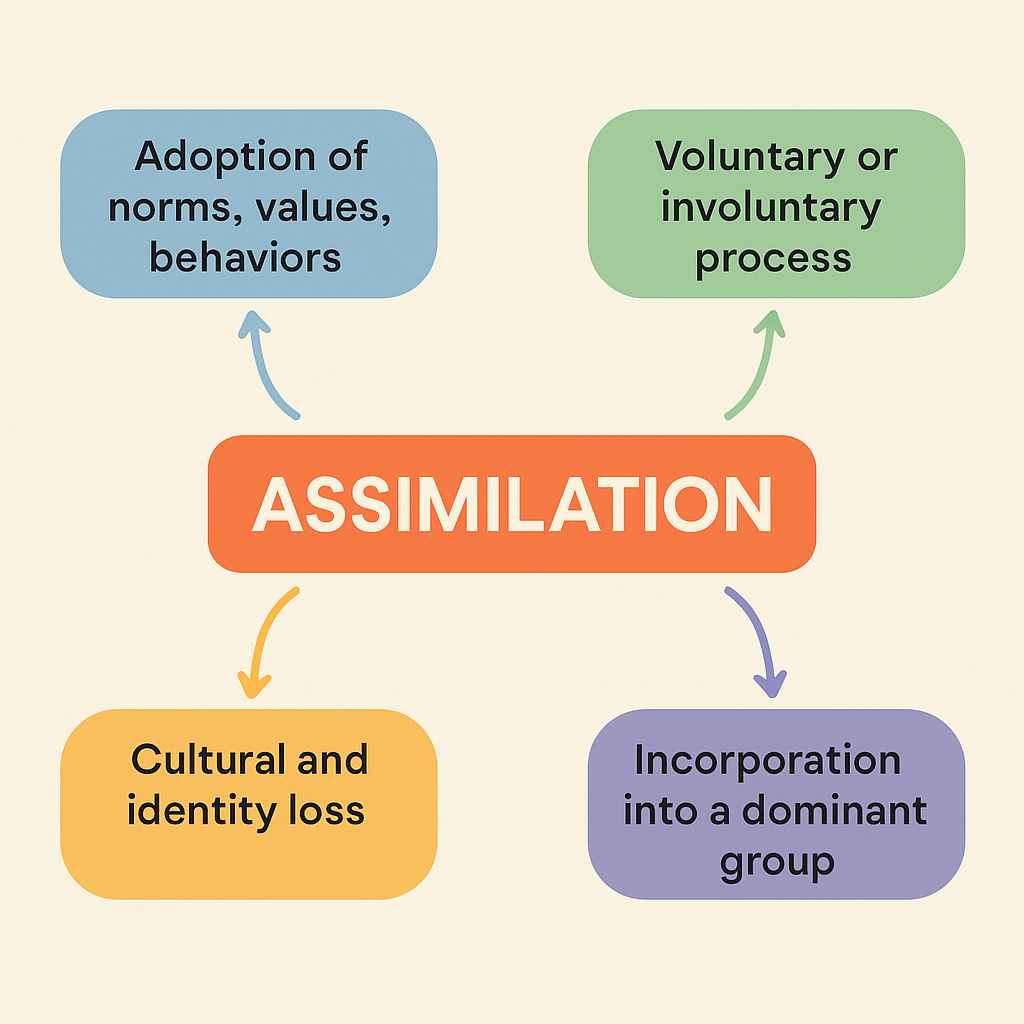
Cultural assimilasjon is perhaps the most commonly debated form. In sociology, it refers to how minority groups gradually adopt the norms, values, language, and behaviors of a dominant culture. American sociologist Milton Gordon’s model (1964) outlines multiple stages of assimilation — from cultural and structural to marital and civic.
In Norway, this process is evident in how immigrant populations, such as those from Syria, adapt to local norms. Language acquisition often marks the first step. Mastering Norwegian (either Bokmål or Nynorsk) opens doors to education and employment, creating pathways for structural integration. A study by Brekke (2021) on Syrian refugees in Scandinavia highlighted how language proficiency not only fosters inclusion but also creates inner conflicts — many individuals struggle to balance their native identity with the expectations of the host society.
Voluntary vs. Forced Assimilation
Assimilasjon can be a product of free choice or coercion. Voluntary assimilation often emerges from practical needs — immigrants choosing to adapt in order to secure better opportunities or contribute to their new society. However, history provides stark examples of forced assimilation.
The Sámi people in Norway, for instance, were subjected to aggressive assimilationist policies from the 19th to 20th centuries. The Norwegian government enforced mandatory schooling in Norwegian and prohibited the use of Sámi languages. According to the 2023 Norwegian Truth and Reconciliation Commission, this systemic erasure inflicted lasting trauma and identity loss across generations. Such cases reveal that assimilasjon can, when forcefully applied, act as a tool of cultural oppression rather than integration.
Identity and Belonging
Assimilation often raises a critical question: Does adapting to another culture mean abandoning one’s own? While some argue that assimilation strengthens national unity, others warn that it risks cultural homogenization. UNESCO reports (2019) show that over 40% of global languages are endangered — many because communities are pressured to abandon their linguistic heritage in favor of dominant tongues.
Losing a language also means losing unique worldviews. Linguistic anthropologists argue that every language carries embedded knowledge, including ecological wisdom, kinship models, and oral traditions. Thus, when cultural assimilasjon becomes one-sided, it not only marginalizes individuals but also diminishes global cultural diversity.
Assimilasjon in Linguistics
Phonological Adaptation
In linguistics, assimilasjon refers to a process where one sound becomes more like a nearby sound to make speech smoother and faster. This type of change occurs naturally in most spoken languages and is a key mechanism in language evolution.
For example, in Norwegian, the phrase “en bil” (a car) may be pronounced as [embiːl], where the nasal sound /n/ becomes /m/ due to the influence of the following /b/. A similar process occurs in English when “input” is pronounced [ɪmpʊt], as the /n/ assimilates to the bilabial /p/.
Broader Linguistic Impact
Assimilasjon in speech is more than a matter of pronunciation — it reflects deep linguistic structures. Over centuries, cumulative sound changes from assimilasjon have played a significant role in transforming languages. For example, the evolution from Old to Modern English involved multiple assimilations that simplified and regularized pronunciation.
In theoretical linguistics, models like Optimality Theory explain assimilation as a trade-off: while it improves ease of articulation, it can reduce the distinctiveness of sounds, making words harder to differentiate. Furthermore, sound shifts contribute to dialect formation and divergence, enabling new forms of regional identity. Haugen (1972) noted that these shifts in Scandinavian languages often follow patterns tied to social interactions, not random chance.
Assimilasjon in Biology
Nutrient Absorption and Metabolism
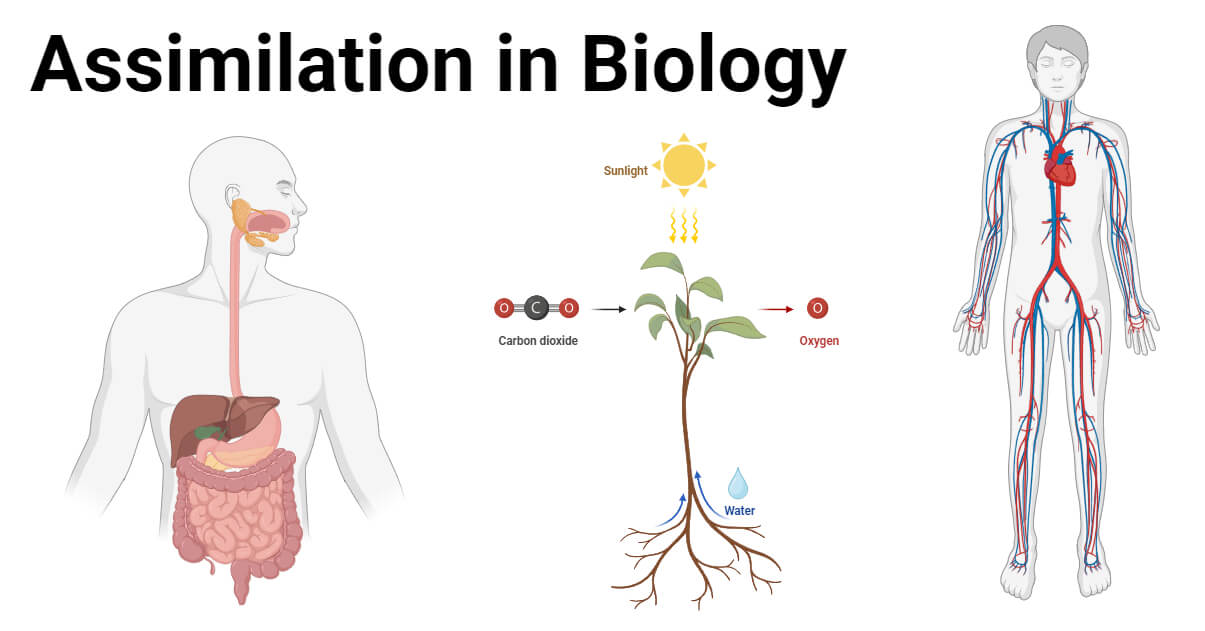
Biologically, assimilasjon is a vital process for all living organisms. It refers to how cells incorporate substances from the environment to grow, repair, and sustain themselves.
In plants, carbon assimilation occurs during photosynthesis — the Calvin cycle captures carbon dioxide (CO₂) and converts it into glucose. Similarly, nitrogen assimilasjon allows plants to take up nitrates from the soil and turn them into amino acids.
In animals and humans, assimilasjon happens in the digestive and cellular systems. Food is broken down, nutrients are absorbed, and these components are reassembled into proteins, enzymes, or stored as energy. For example, glucose is assimilated into glycolysis pathways to produce ATP — the energy currency of cells.
Health Implications
When biological assimilasjon fails, health deteriorates. In conditions like celiac disease or Crohn’s disease, the small intestine becomes inflamed or damaged, preventing proper nutrient absorption. This leads to malnutrition, fatigue, and other systemic issues — even when food is available.
According to the World Health Organization (2022), millions in developing regions suffer from malnutrition not because of food scarcity, but because of poor assimilation due to chronic infections or gut disorders. Thus, assimilasjon connects the micro-scale of cell function with the macro-scale of global health and development.
Comparing the Different Dimensions of Assimilasjon
| Point | Society & Culture | Linguistics | Biology |
|---|---|---|---|
| Core Idea | Cultural adoption by minority groups. | Sound adaptation for articulation. | Nutrient incorporation in cells. |
| Key Example | Sámi assimilation in Norway. | “Input” pronounced as [ɪmpʊt]. | CO₂ fixation in the Calvin cycle. |
| Primary Benefit | Social inclusion and upward mobility. | Efficient and fluid speech. | Energy production and growth. |
| Major Challenge | Identity loss and cultural trauma. | Loss of sound distinction. | Malnutrition due to poor absorption. |
These different applications of assimilasjon reveal a unifying theme: the process of becoming part of a greater system. Whether social, phonological, or biological, assimilation aims at integration — but always with trade-offs.
Contemporary Debates Around Assimilation
Immigration, Multiculturalism, and National Identity
Today, assimilasjon remains a contested issue in politics and policy, especially in multicultural societies. In Europe, debates often pit assimilationist approaches against multiculturalist ideals. Assimilationists argue that national unity depends on shared language, values, and civic duties. In contrast, multicultural theorists like Will Kymlicka (1995) argue for “group-differentiated rights” — protecting minority customs within a larger democratic framework.
Programs across the European Union from 2018–2024 promote “interculturalism,” a middle path encouraging interaction between cultures rather than requiring assimilation. These models suggest that cultural integration need not mean cultural erasure.
The Digital Age and Cultural Assimilation
With globalization and digital technology, a new form of assimilasjon is taking place. Social media platforms like TikTok and Instagram transmit global cultural trends at lightning speed, influencing fashion, slang, and social norms. But instead of one-way assimilation, many users adapt and remix these trends into local versions.
Research by Miller et al. (2021) at UCL shows that digital youth cultures create “glocal” identities — hybrids of global and local influences. Thus, modern assimilasjon is increasingly fluid, participatory, and reciprocal.
FAQs
1. Is assimilasjon always voluntary?
No. While assimilation can occur naturally, history shows that it is often imposed by dominant powers through education, law, or social pressure.
2. How does assimilation differ from integration?
Assimilation involves adopting the dominant culture entirely, while integration allows individuals to maintain their original culture within a shared social space.
3. Can assimilasjon impact future generations?
Yes. Cultural, linguistic, and even genetic traits can shift over generations, especially when assimilation is institutionalized.
4. Is linguistic assimilation a bad thing?
Not necessarily. It makes communication smoother, but excessive phonological assimilation can reduce clarity or contribute to dialect loss.
5. Why is biological assimilation important for health?
It allows the body to absorb nutrients and sustain life. When assimilation fails, as in malabsorption disorders, it can lead to serious health problems.
Conclusion
Assimilasjon is far more than a simple concept of blending in — it is a complex, layered process that touches nearly every aspect of life. In society, it raises important questions about identity, justice, and unity. In language, it reflects both efficiency and the creative force of communication. In biology, it is a core mechanism that enables life to flourish. Recognizing assimilasjon in its multiple forms allows us to better appreciate how systems — whether cultural, linguistic, or biological — grow stronger through adaptation. Yet, the challenge remains: how can we assimilate without erasing? That balance may indeed be the true key to cultural understanding.


