









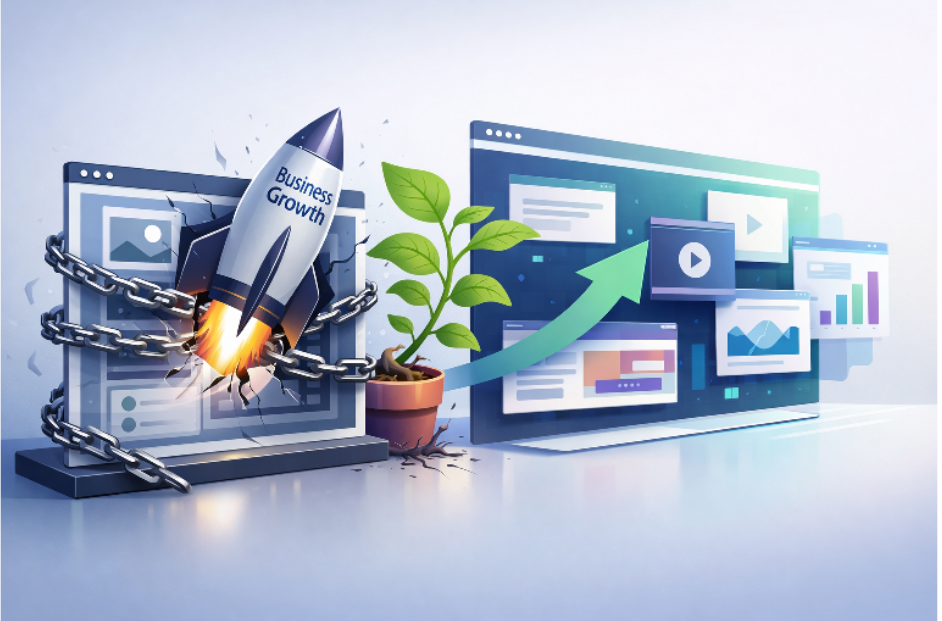
DIY website builders such as Wix, Squarespace, and Shopify have made it remarkably easy for businesses to launch websites without technical expertise. With drag-and-drop interfaces, pre-designed templates, and built-in hosting, these platforms allow entrepreneurs and small teams to establish an online presence quickly and affordably. For many startups and small businesses, this convenience is exactly what they need in the early stages.
However, as businesses grow, their digital requirements become more complex. What initially felt like a flexible solution can gradually reveal structural limitations that affect performance, customization, scalability, and marketing potential. While website builders serve an important role in early-stage digital development, they are not always designed to support businesses that are scaling rapidly.
Understanding these limitations can help business owners make more strategic decisions about their long-term digital infrastructure.
Why DIY Website Builders Are Attractive to New Businesses
For new businesses, launching quickly and cost-effectively is often the top priority. DIY website builders address this need by simplifying the entire website creation process.
Most platforms offer pre-built templates, integrated hosting, and user-friendly editors that require little to no coding knowledge. Business owners can create pages, add images, update content, and publish their websites within hours rather than weeks. This accessibility significantly lowers the barrier to entry for companies that may not yet have the budget to hire designers or developers.
Another advantage is predictable pricing. Monthly subscription models allow businesses to manage their costs while accessing built-in tools such as analytics, contact forms, and e-commerce capabilities. For early-stage startups testing a product or validating a market, this simplicity can be extremely valuable.
However, the convenience that makes website builders appealing at the beginning can also create structural limitations as businesses expand.
The Customization Ceiling That Growing Businesses Eventually Hit
As companies mature, their websites typically evolve from simple informational pages into complex digital platforms. Businesses may need custom features, unique user experiences, advanced integrations, or specialized workflows that go beyond standard templates.
This is where many DIY website builders begin to show their limitations. Although they offer visual editors and basic customization options, the underlying framework often restricts deeper modifications. Developers usually have limited access to the platform’s core codebase, making it difficult to implement highly specific functionality.
For example, a growing company might want a tailored product configurator, a membership portal, or a custom booking workflow. These types of features often require more development flexibility than website builders allow. As a result, businesses may find themselves constrained by the platform’s built-in capabilities.
In these situations, companies sometimes explore more adaptable frameworks supported by specialized teams, such as a custom wordpress development company, which can design and implement features tailored to the organization’s unique needs. The goal is not necessarily complexity, but flexibility—ensuring the website can evolve alongside the business.
When customization becomes critical to the user experience or operational efficiency, the limitations of DIY platforms can become increasingly noticeable.
Performance and Speed Limitations That Impact Growth
Website performance plays a significant role in both user experience and conversion rates. Slow-loading pages can lead to higher bounce rates, reduced engagement, and lost revenue opportunities.
Many DIY website builders operate within shared infrastructure environments where thousands of websites rely on the same underlying platform architecture. While this model simplifies hosting and maintenance, it also limits how much businesses can optimize performance.
Templates often include large amounts of code designed to support many potential design elements, even if those elements are not used. This additional code can increase page load times and reduce overall efficiency. Businesses also typically have limited control over server configurations, caching strategies, and advanced performance optimization techniques.
For companies experiencing increased traffic, these performance constraints can become more visible. As marketing campaigns scale or product demand grows, the website must be able to handle higher volumes of visitors without slowing down or creating friction in the user journey.
When performance directly affects lead generation or e-commerce conversions, businesses often begin to reconsider whether their current platform can support long-term growth.
SEO Constraints That Limit Organic Visibility
Search engine optimization (SEO) is another area where DIY website builders can present challenges for growing businesses.
Most platforms include basic SEO tools such as editable meta tags, simple sitemaps, and page-level optimization settings. These features are sufficient for small websites targeting limited keyword sets. However, more advanced SEO strategies often require deeper control over technical infrastructure.
For example, larger websites may need highly customized URL structures, advanced schema markup, dynamic page generation, or granular control over indexing behavior. Implementing these elements can be difficult or sometimes impossible within the constraints of certain website builders.
Additionally, businesses operating in competitive industries often rely on technical SEO improvements such as server-side performance optimization, custom content architectures, and advanced internal linking strategies. Limited access to backend functionality can make these improvements difficult to implement.
Over time, these restrictions can affect a company’s ability to compete effectively in search results, especially when competitors operate on more flexible platforms.
Integration and Automation Challenges
As businesses scale, their digital ecosystems become more interconnected. Websites no longer operate as standalone marketing assets but instead function as central hubs that integrate with multiple tools and systems.
Common integrations include customer relationship management (CRM) systems, marketing automation platforms, email marketing tools, inventory management software, and analytics platforms. These integrations enable businesses to automate workflows, streamline operations, and create more personalized customer experiences.
While many website builders provide app marketplaces or plugin libraries, these integrations are often limited to predefined use cases. Custom integrations can be difficult to implement due to restricted access to the platform’s underlying architecture.
For example, a growing company might want to connect its website directly to internal business systems or create automated workflows between its CRM and marketing platforms. Achieving this level of integration may require APIs, custom development, or middleware solutions that are not fully supported within DIY platforms.
As operational complexity increases, integration limitations can become a significant bottleneck.
Branding and User Experience Restrictions
Brand differentiation is essential for businesses operating in competitive markets. A website is often the first interaction potential customers have with a brand, making design and user experience critically important.
DIY website builders typically rely on templates to simplify the design process. While these templates are visually appealing and easy to customize at a basic level, they can also create uniformity across websites.
Businesses may find that their design options are constrained by the structure of the template. Certain layouts, animations, or interactive elements may not be possible without extensive workarounds. Even when customization options exist, they are usually limited to adjustments within predefined frameworks.
As companies grow and invest more heavily in brand identity, these limitations can become more noticeable. A business may want a unique user journey, interactive product showcases, or advanced storytelling elements that differentiate its brand from competitors.
Achieving this level of creative control is often difficult within the boundaries of template-based platforms.
The Hidden Long-Term Costs of DIY Platforms
One of the primary selling points of website builders is affordability. Monthly subscription plans appear cost-effective compared to hiring developers or building a custom website.
However, the long-term financial picture can be more complex.
Businesses often pay for multiple premium features, third-party apps, e-commerce transaction fees, and higher-tier plans as their needs grow. Over time, these recurring costs can accumulate significantly.
Additionally, when a company eventually decides to migrate away from a website builder, the process can be expensive and time-consuming. Many platforms store website structures in proprietary formats that are difficult to export cleanly. As a result, businesses may need to rebuild their websites entirely on a new platform.
This migration cost is rarely considered when companies first choose a DIY solution, but it can become a major factor later in the business lifecycle.
When Businesses Should Consider Moving to a More Flexible Website Solution
Not every business needs to abandon website builders immediately. For early-stage companies with simple requirements, these platforms can be highly effective.
However, there are clear indicators that a business may benefit from transitioning to a more flexible solution.
Rapid growth in website traffic, expanding product catalogs, complex integrations, and advanced marketing strategies are common signals. Similarly, businesses that rely heavily on SEO, content marketing, or custom user experiences often require greater control over their website infrastructure.
Moving to a more flexible platform does not necessarily mean increasing complexity. Instead, it allows businesses to build a digital foundation that supports growth, innovation, and evolving customer expectations.
Evaluating this transition proactively—rather than reactively—can help companies avoid performance bottlenecks and costly rebuilds later.
Conclusion
DIY website builders have played an important role in democratizing website creation. They provide an accessible entry point for startups and small businesses that need to establish an online presence quickly and affordably.
However, as businesses grow, their websites must support more sophisticated marketing strategies, operational integrations, and user experiences. Limitations in customization, performance optimization, SEO control, and system integration can gradually become barriers to growth.
Understanding these hidden constraints allows business owners and marketing leaders to plan more strategically for the future. A scalable website infrastructure ensures that digital platforms can evolve alongside the business, supporting expansion rather than restricting it.
For companies focused on long-term growth, investing in flexible and adaptable web solutions can ultimately provide the foundation needed to compete effectively in an increasingly digital marketplace.