









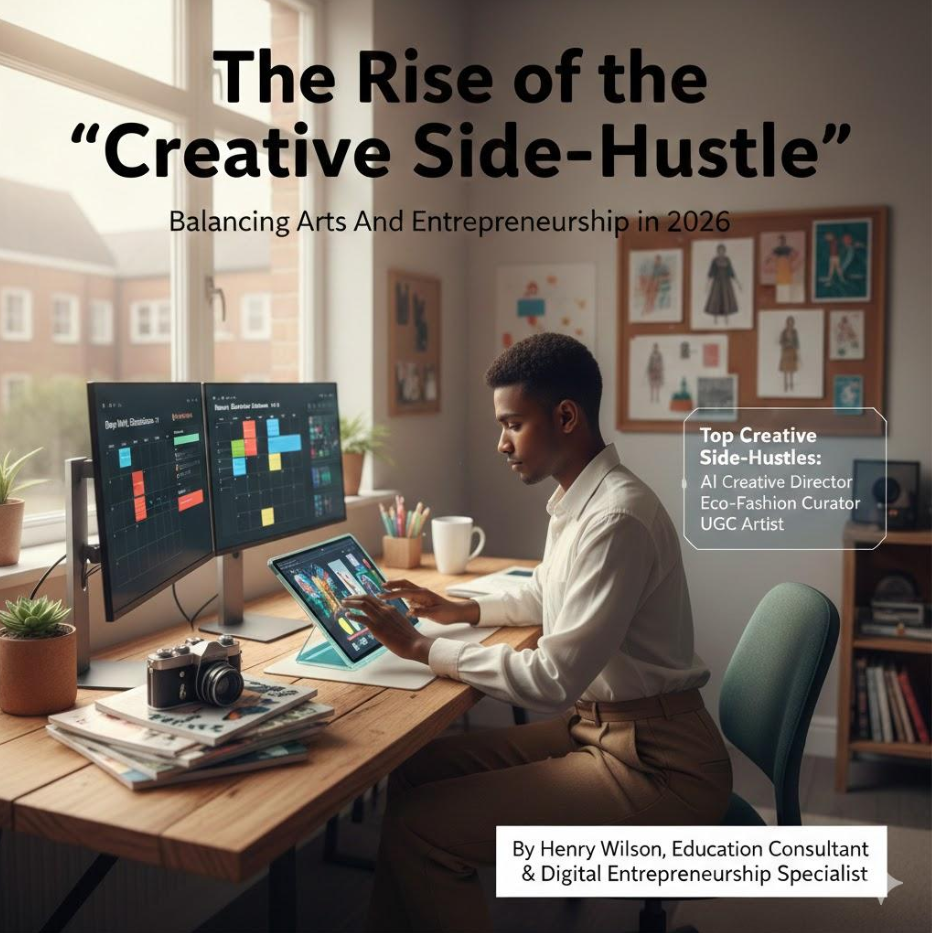
By Henry Wilson
Education Consultant & Digital Entrepreneurship Specialist
The era of the “broke student” is officially over. As we navigate the 2026 academic year, the UK education landscape has shifted from passive learning to active creation. Recent data indicates that over 65% of UK students—from Sixth Formers to Postgraduates—are now running digital ventures from their desks.
While traditional retail roles haven’t vanished, the modern student is more likely to be a digital architect than a shelf-stacker. From AI-assisted visual arts to circular fashion curation, the “side-hustle” has replaced the internship as the ultimate CV builder. For those at the intersection of A-Levels and University, you aren’t just preparing for the workforce—you’re disruption-proofing your future.
Why 2026 is the “Golden Era” for Student Founders
In my work as an education consultant, I’ve seen three factors converge to make this the most viable time for a student startup in the UK:
- AI Democratisation: Generative tools have leveled the playing field. A photography student can now perform complex retouching or market analysis in seconds—tasks that previously required a professional studio team.
- The Micro-Gallery Economy: Platforms like TikTok Shop and Vinted have made monetisation “frictionless.” The barrier to entry isn’t a £10,000 loan; it’s a high-impact, 30-second video.
- Financial Autonomy: With the UK cost of living remaining a primary concern, side hustles are no longer for “pocket money”—they are vital tools for building early equity and reducing student debt.
Top Creative Side-Hustles in the 2026 UK Market
| Niche | Skills Needed | 2026 Growth Potential |
| AI Creative Director | Prompt Engineering / Design | High – Brand demand is surging |
| Eco-Fashion Curator | Styling / Sustainability | Very High – Driven by Gen Alpha |
| UGC Artist | Video Editing / Storytelling | Massive – Brands want “authentic” voices |
| Micro-Tutoring | Subject Specialism | Steady – High demand for A-Level/IB |
The Balancing Act: Academics vs. Ambition
The biggest hurdle for any student founder is “Double Life” syndrome. How do you manage a client’s product launch on the same day as your mock exams or your final dissertation deadline? To succeed, you must move from a “student” mindset to a “founder” mindset.
1. Time-Blocking and “The Creative Sprint”
I always advise my mentees to use Time-Blocking to prevent context switching. Separate your “Deep Work” (University assignments) from your “Business Growth” (Client work). In 2026, focused attention is your most valuable asset.
2. Strategic Outsourcing
Smart entrepreneurs know when to delegate. In the corporate world, CEOs don’t do their own data entry; in the academic world, student founders shouldn’t let a 4,000-word essay stall their business momentum. When the pressure of scaling a startup threatens your grades, leveraging professional academic assignment help for research assistance and proofreading allows you to maintain your academic standing without sacrificing your entrepreneurial growth.
3. The “Academic First” Anchor
Your degree is your “anchor” project. While the side-hustle is the laboratory for real-world skills, your formal education provides the theoretical framework and long-term insurance policy for your career.
Legal and Financial Essentials for UK Students
Before scaling your creative empire, you must navigate these UK-specific logistics:
- HMRC and the Trading Allowance: You can earn up to £1,000 in “trading income” tax-free per year. Once you cross this, you must register for Self-Assessment.
- Age Requirements: Most platforms like Shopify or Etsy require users to be 18. Sixth Form founders under 18 may need a parent to act as a nominee.
- University IP Policies: If you’re using university-provided software, check your institution’s Intellectual Property policy. For complex legal or business questions, seeking report writing help can provide the clarity needed to document your business operations correctly.
- Mental Health: “Hustle culture” is a double-edged sword. Prioritise your well-being to ensure both your business and your degree remain sustainable.
Frequently Asked Questions
Q.1 Do I need to pay tax on my side hustle if I am a full-time student?
In the UK, you have a £1,000 “Trading Allowance.” If your annual gross income is under this, you generally do not need to report it. Beyond this, you must register as a sole trader.
Q.2 How do I prevent my business from affecting my university grades?
The key is strategic delegation. High-achieving student founders treat their business like a modular project and use academic support services during peak business cycles to stay on top of coursework.
Q.3 Does my university own the work I create on campus?
This depends on the IP clause in your student handbook. If you use university-funded equipment or specialized software, they may have a claim. Always read the fine print before launching.
Conclusion: Your Future Starts Now
The rise of the “Side-Hustle Student” is a testament to the resilience of the UK’s younger generation. By leveraging modern AI tools, maintaining a strict balance, and knowing when to lean on professional support, you aren’t just surviving university—you’re building a foundation for a lifelong career of innovation.
About the Author
Henry Wilson is a renowned UK-based author and education consultant specializing in the intersection of the digital economy and student success. Alongside his work with Myassignmenthelp.com, he has over a decade of experience mentoring young creatives through UK university incubators.