









If you have explored software development recently, you have probably noticed how different things look compared to just a few years ago. Tools that once required technical teams can now be used by almost anyone. Among all these changes, one shift is especially clear: no-code platforms are no longer niche tools. They are becoming a core part of how products get built.
What makes this change so important is accessibility. Modern platforms have simplified development into visual workflows and AI-driven processes. Entrepreneurs, teachers, and creators who never studied programming can now build real applications used by real customers.
The progress has been dramatic. Early no-code platforms were mostly limited to simple landing pages or demo projects. Today’s tools support complex workflows, user systems, payments, and scalable infrastructure. They are no longer experiments. They are real development options.
Why Businesses Still Need Apps in 2026
Some business owners still ask whether they really need an app if their website already works well on mobile. The short answer is yes.
User behavior has changed. People prefer apps because they are faster, easier to access, and more personalized than websites. Opening an app feels more natural than searching through browser tabs.
From a business perspective, apps also strengthen customer relationships. When your product sits on someone’s home screen, your brand becomes part of their daily routine. Websites rarely create this level of engagement.
The numbers confirm this shift. Mobile apps typically show stronger engagement and higher conversion rates compared to mobile websites. Customers spend more time browsing and are more likely to complete purchases.
By 2026, having a website is expected. Having a strong app is what creates competitive advantage.
The Real Advantages of No-Code App Builders
After deciding to build an app, the next challenge is choosing how to build it. Hiring developers is one option, but it often means high costs, slow timelines, and complicated coordination.
No-code platforms offer a simpler alternative. They allow businesses to create applications faster and at a fraction of the cost.
The main purpose of any no-code tool is efficiency. AI-driven builders can now generate software with many of the same capabilities as traditionally coded products, but much faster.
Since development time and cost always matter, the right platform should reduce both. That is exactly why modern no-code builders are becoming essential tools rather than optional ones.
What Makes MeDo the Best No-Code Builder Right Now
Among the many platforms available today, MeDo positions itself as one of the strongest options for building complete applications without technical complexity. After testing the platform in real projects, several advantages become clear.
1. Complete apps instead of partial builds
Many no-code tools only solve part of the development process. Some help you design interfaces but leave infrastructure tasks to you. That often becomes the point where projects slow down.
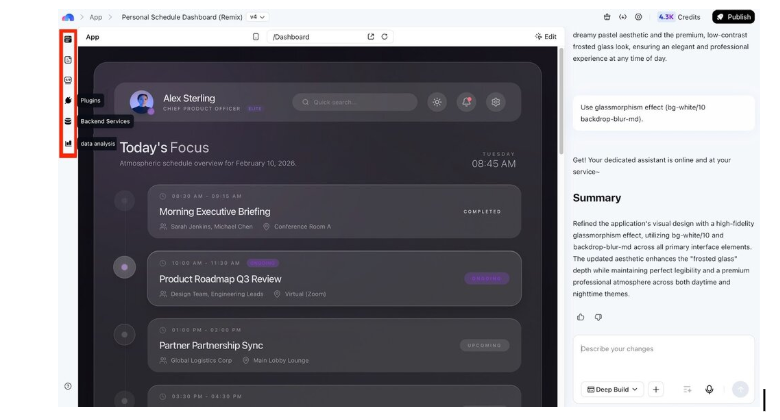
MeDo approaches this differently. Its AI generates the interface, database structure, and integrations together. When the build finishes, the product is already functional.
There is no need to configure external services. No need to worry about hosting setup. Everything is handled in one place.
For founders and creators, this removes weeks of technical setup.
2. Designed for non-technical users
Some platforms still expect users to understand technical terms. Words like API, backend logic, and database queries can quickly make a tool feel less beginner-friendly.
MeDo focuses on simplicity. It assumes users have ideas, not engineering backgrounds.
If problems appear during development, the system often resolves them automatically. Users do not need to debug errors manually or search technical forums.
Another useful feature is visual recreation. Uploading a screenshot of an existing interface allows MeDo to rebuild the layout into an editable project. This removes the need for design experience.
3. Strong integration ecosystem
An app is only valuable if it can support real users and real transactions. MeDo’s plugin ecosystem helps projects move beyond prototypes.
For example, Stripe integration can be added quickly to enable payments. Media processing tools like Nano Banana Pro can extend functionality. Developers can also add custom plugins when needed.
This flexibility ensures projects are not limited by default features.
4. Built for real-world scale
Some no-code tools are excellent for demonstrations but struggle when real users arrive. Performance, scaling, and payment reliability can become problems.
MeDo is built to support production use from the beginning. SaaS tools, business platforms, games, and mobile utilities can all run on its infrastructure.
The platform has already supported the creation of more than one million applications. These range from small tools to complex commercial software.
This track record shows the platform is designed for real deployment.
5. Flexible and practical pricing
Subscription pricing is common in the no-code space. Many platforms require monthly payments whether you actively build or not.
MeDo uses a credit model instead. Users receive 100 free credits every day. This allows experimentation without financial pressure.
Paid plans start at $20 for 2000 credits. Compared with platforms like Replit or Lovable, this model can be significantly more cost-efficient.
Users only pay when they actively build. No wasted subscription months.
6. Types of products users create
Projects built on MeDo cover a wide range of use cases:
- SaaS platforms with user dashboards
- Interactive games
- Mobile business applications
- Internal company tools
- E-commerce platforms
- Education software
Each project includes backend systems, databases, and real user support. These are not mockups. They are fully functional applications.
Wrapping Up
After building and launching several projects with MeDo, one thing becomes clear. The platform delivers what many no-code tools promise but do not fully achieve: the ability to build real software without technical barriers.
One detail worth highlighting is accessibility. Anyone can start using MeDo immediately with daily free credits. No payment details are required.
For anyone trying to avoid the cost and complexity of traditional development, MeDo offers a practical alternative. It is simple enough for beginners but powerful enough for real products.
For builders who want to turn ideas into working software quickly, it is definitely worth exploring.